Language of Kilims

Kilim, a word of Turkish origin, refers to a piece of textiles woven with a flat-weaving technique. Today’s Anatolian Kilim is the expression of a tradition dating back an impressive 9,000 years.
The question is, are they expressing more than tradition?
“The woven patterns in kilims kept alive an unconscious inner dialogue between the women of anatolia and their foremothers”
Like Dario, many researchers believe kilim motifs make up a unique language linking centuries of people who crossed paths.
In Turkiye, the idea that these motifs are derived from ancient symbols, which are used to communicate and convey ideas is widely accepted. Some people believe this language to be abstract, while others believe it is even possible to 'read' a Kilim.
What we know for sure is that these symbols can have different interpretations, and the absence of an official written index only adds to the mystery.
We’ve done our research to present you some common kilim motifs side by side with their widely accepted meanings.
Why not have a go at identifying motifs you spot in your own kilims?

Exploring this incredible language, we created Tokens of a Forgotten Language, where we brought together symbols normally found on Kilims to create different themed knitware.
࿐
follow the trail

Patchwork cushion covers made from upcycled kilims.
Material: Wool Front & Cotton Back
Measures: 43 x 43cm (Set of 2)
Notes: Does not include cushions.

Into Christmas but not into the usual Christmas aesthetic? Have yourself a stocking made from an upcycled kilim.
Good parts of worn-out flatwoven rugs are turned into stockings in this unusual project where East and West meet!
Feel free to go solo or buy in pairs, match them or mismatch.
Material: Wool Front, Cotton Lining, Satin Back
Measures: ~43.5 x 30cm
Notes: Ready to Hang | These come with an ice-blue satin back in different patterns.

These handmade mules are made to be worn outside, or inside on a cozy day.
A project by Power Duo Özlem & Ezgi of Loop Arts, shoes in this range are all upcycled. The couple travel to villages of Turkey to find worn out kilims, and use their good parts to turn them into handmade shoes - so the patterns are unique on each shoe! That’s not all - with every pair you will receive more information about the age and origins of your Kilim.
To find out more about Kilims head to our Glossary.
Material: Genuine Leather & Wool Upper & Rubber Heel
Size (UK): 8.5

These handmade mules are made to be worn outside, or inside on a cozy day.
A project by Power Duo Özlem & Ezgi of Loop Arts, shoes in this range are all upcycled. The couple travel to villages of Turkey to find worn out kilims, and use their good parts to turn them into handmade shoes - so the patterns are unique on each shoe! That’s not all - with every pair you will receive more information about the age and origins of your Kilim.
To find out more about Kilims head to our Glossary.
Material: Genuine Leather & Wool Upper & Rubber Heel
Size (UK): 5.5

One-of-a-kind patchwork cushion covers made from upcycled kilims.
Can be bought as a set or separately.
Material: Wool Front & Cotton Back
Measures: 45 x 45 cm
Notes: This entry is only for the cushion cover and does not include cushions.

One-of-a-kind patchwork cushion covers made from upcycled kilims.
Can be bought as a set or separately.
Material: Wool Front & Cotton Back
Measures: 45 x 45 cm
Notes: This entry is only for the cushion cover and does not include cushions.

A unique project looking into the forgotten language* found on Turkish kilims, expertly hand-knitted by Pakize Akçakese. Only five individual items of knitwear, exploring five different themes.
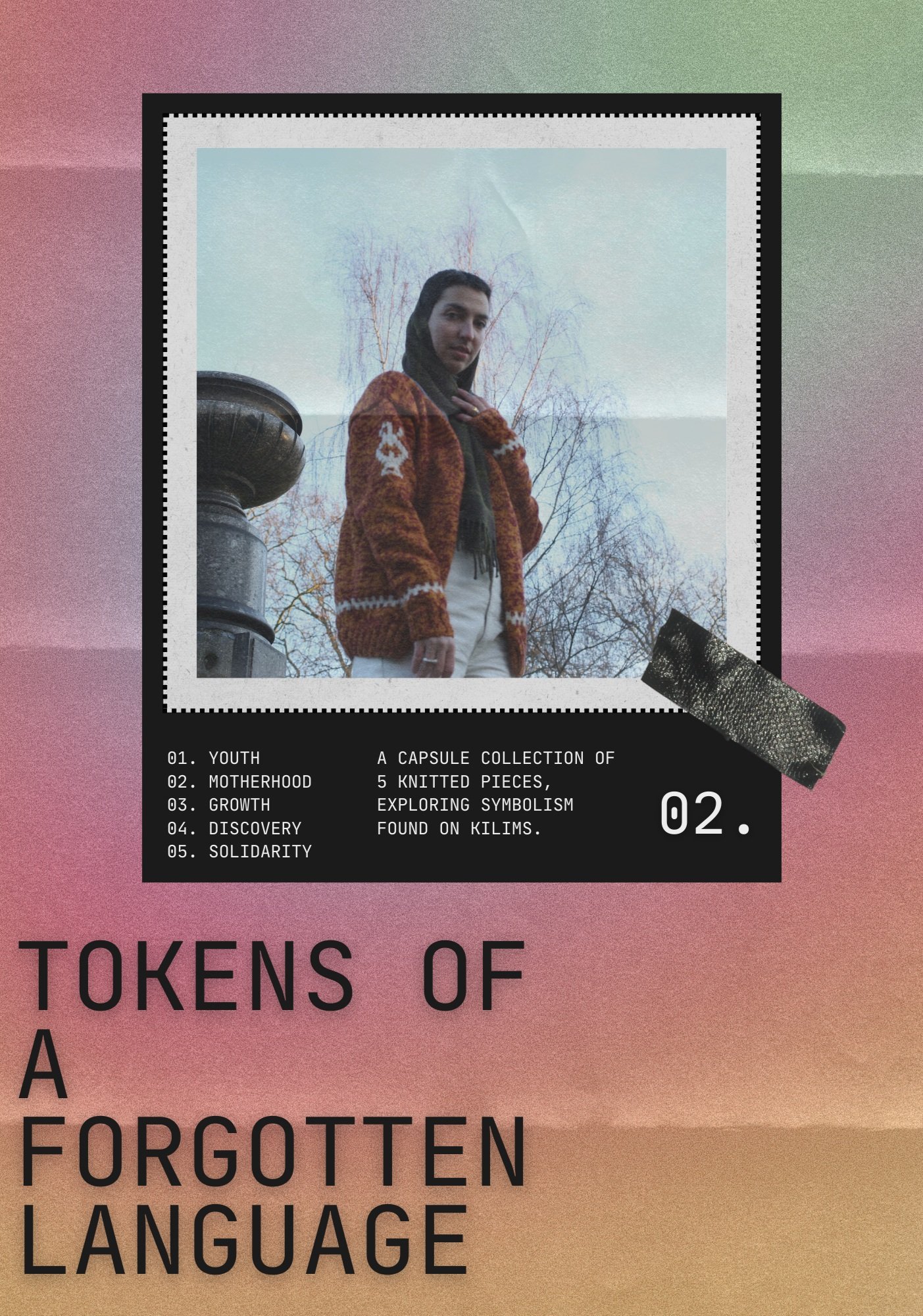
We put together symbols of a Ewer (arm), a Scorpion (back) and Hands on Hips (chest) to represent ‘Motherhood’.
Ewers are vase-shaped pitchers, representing purity. Despite the ugly sides of motherhood being a taboo subject in societies, you would be hard finding a mother who believes the journey of motherhood to be one of purity and perfection. So maybe, more importantly, we can re-write this complex journey away from this false narrative and celebrate the sheer urge to keep going as the purest aspect of motherhood.
Scorpions represent liberty, to symbolise an experience of motherhood, where mothers get to choose their own mould and write their own story, whatever that may be.
Hands on Hips is a stylised depiction of a female, representing life and womanhood. This symbol is often used to indicate that a kilim has been woven by a woman, which applies to these knitwear too. It is women writing themselves into history, and used here as a symbol of female solidarity.
*There is no written-index for this language, and though Weavers generally agree on the meaning behind most symbols, they are also open to interpretation, which is the beauty of it. You can learn more here.
Material: 100% Wool & Olive Wood Buttons
Details: Loose fit | Unisex
Size: M-L | Melis, pictured, is a size S
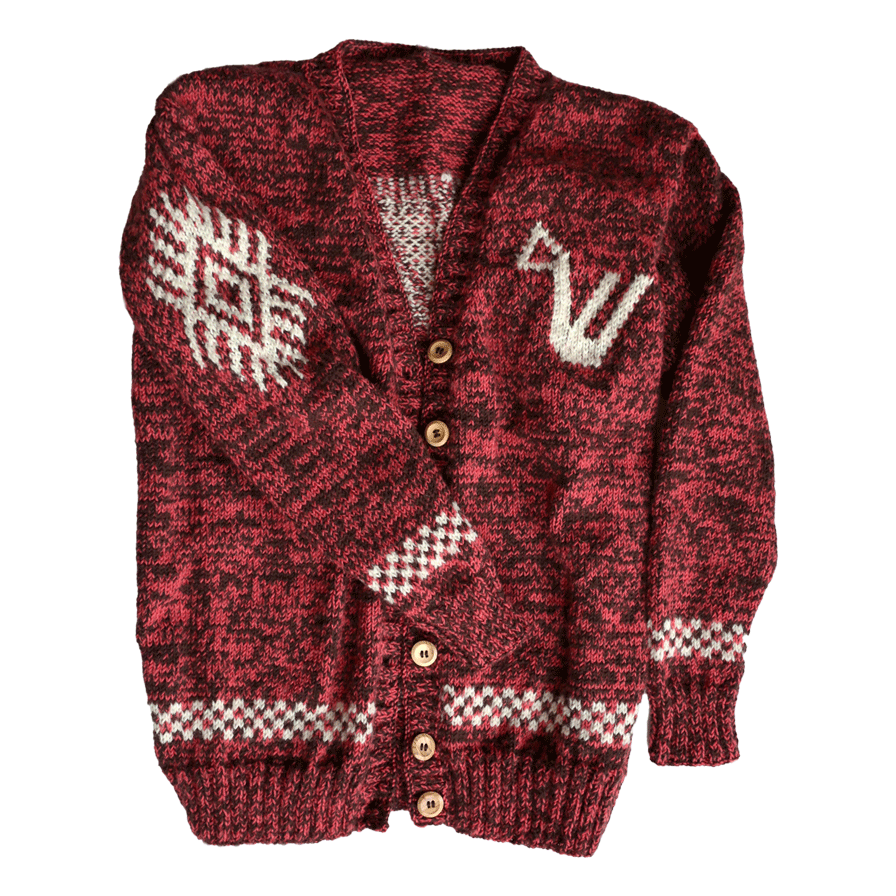
A unique project looking into the forgotten language* found on Turkish kilims, expertly hand-knitted by Pakize Fidan. Only five individual items of knitwear, exploring five different themes.
Think of ‘youth’ not in an anti-aging kind of way, but as a concept irrelevant to our bodies. We put together symbols of a Bird (chest), a Burdock (arm) and Running Water (back) to represent ‘Youth’.
Running Water represents life, and the fact that everything is always changing. We do not have to hold onto time to feel young. Running water is the opposite of stagnant. To us, a mind that is stimulated is the mind of someone who is youthful.
Birds, in this case, represent expectance of good news. Expectation and hope can both be crucial elements of a moving mind. The overarching idea in the world is that we ‘peak’ in our 30s and have fewer expectations of our lives from that point onwards. We happily challenge this.
Burdocks represent protection against the evil eye, which we included to symbolise a healthy life free from judgements of others. After all, you’ve got to have courage to take ‘youth’ out of the age bracket we’re told it belongs.
*There is no written-index for this language, and though Weavers generally agree on the meaning behind most symbols, they are also open to interpretation, which is the beauty of it. You can learn more here.
Material: 100% Wool & Olive Wood Buttons
Details: Loose fit | Unisex
Size: L-XL | Model is a size XL

A unique project looking into the forgotten language* found on Turkish kilims, expertly hand-knitted by Pakize Akçakese. Only five individual items of knitwear, exploring five different themes.
We put together symbols of Eyes (chest), a Pomegranate (back) and Love & Union (arm) to represent ‘Growth’.
Pomegranate represents fertility. In the context of this project it implies discovery and revelation. The worthiness of growth is reflected in the thriving fruitfulness of the pomegranate.
Eyes imply protection from evil glares, judgement and envy. It is believed that the harms these may cause can best be prevented, again, by a human eye in a mirroring effect. The basis of growth requires going outside of one’s comfort zone, which takes courage and may require looking at a challenge in the eye.
Love & Union This is a symbol of dualism, inherited from the Far-East and imported to Anatolia, where it suggests the harmony between two people, or in this case, two sides which are present in all humans. The harmony of the opposing ideas in our minds makes growth far more abundant.
*There is no written-index for this language, and though Weavers generally agree on the meaning behind most symbols, they are also open to interpretation, which is the beauty of it. You can learn more here.
Material: 100% Wool & Olive Wood Buttons
Details: Loose fit | Unisex
Size: XS-S

Amulets bearing Evil Eyes are believed to protect the wearer. Nowadays, such amulets have gone beyond superstition and have truly become a part of Turkish culture. This unusual one displays a traditional kilim design on a Copper plate, and is designed to decorate your walls.
Made by Nurhan Acun of Eller Art Gallery, Istanbul.
Material: Copper plate & Glass beads
Measures: H 27cm, W 9.5cm

These handmade mules are made to be worn outside, or inside on a cozy day.
A project by Power Duo Özlem & Ezgi of Loop Arts, shoes in this range are all upcycled. The couple travel to villages of Turkey to find worn out kilims, and use their good parts to turn them into handmade shoes - so the patterns are unique on each shoe! That’s not all - with every pair you will receive more information about the age and origins of your Kilim.
To find out more about Kilims head to our Glossary.
Material: Genuine Leather & Wool Upper & Rubber Heel
Size (UK): 8.5

These handmade mules are made to be worn outside, or inside on a cozy day.
A project by Power Duo Özlem & Ezgi of Loop Arts, shoes in this range are all upcycled. The couple travel to villages of Turkey to find worn out kilims, and use their good parts to turn them into handmade shoes - so the patterns are unique on each shoe! That’s not all - with every pair you will receive more information about the age and origins of your Kilim.
To find out more about Kilims head to our Glossary.
Material: Genuine Leather & Wool Upper & Rubber Heel
Size (UK): 6

Patchwork cushion cover made from upcycled kilims.
Material: Wool Front & Cotton Back
Measures: 45 x 45 cm
Notes: This entry is only for the cushion cover and does not include cushions.

Patchwork cushion cover made from upcycled kilims.
Material: Wool Front & Cotton Back
Measures: 45 x 45 cm
Notes: This entry is only for the cushion cover and does not include cushions.

A unique project looking into the forgotten language* found on Turkish kilims, expertly hand-knitted by Pakize Akçakese. Only five individual items of knitwear, exploring five different themes.
We put together symbols of an Eye (arm), a Hand (back) and a Grain (chest) to represent ‘Discovery’, whether you’re thinking of discovery in the literal sense or as a metaphor.
Hands, in this case, are linked to the hand of Fatima and symbolise fertility. We used this symbol metaphorically to imply exploration and revelation.
Eyes imply protection from evil glares, judgement and envy. It is believed that the harms these may cause can best be prevented, again, by a human eye in a mirroring effect. The basis of discovery requires going outside of one’s comfort zone, which takes courage and may require looking at a challenge in the eye.
Grain represents abundance. In the context of this project it implies the abundance of human potential and reminds us of the wealth opportunity for discovery, which is easy to overlook.
*There is no written-index for this language, and though Weavers generally agree on the meaning behind most symbols, they are also open to interpretation, which is the beauty of it. You can learn more here.
Material: 100% Wool & Olive Wood Buttons
Details: Loose fit | Unisex
Size: S-M

A unique project looking into the forgotten language* found on Turkish kilims, expertly hand-knitted by Pakize Akçakese. Only five individual items of knitwear, exploring five different themes.
We put together symbols of a Snake (chest), an Amulet (back) and Tree of Life (arm) to represent ‘Solidarity’.
Snake motifs are used for protective purposes, included here to represent protection of, not only ourselves, but also of those who we stand in solidarity with.
Amulets, like eye symbols, are believed to reduce the effects of an evil glance, and judgement and envy of others. In the context of this project, it symbolises the courage to stand up for what we believe, despite what others may think.
Tree of Life represents life itself. An important element of life is our sense of belonging and purpose. In relation to solidarity, this symbol represents establishing roots in your community or building your own principles.
*There is no written-index for this language, and though Weavers generally agree on the meaning behind most symbols, they are also open to interpretation, which is the beauty of it. You can learn more here.
Material: 100% Wool & Olive Wood Buttons
Details: Loose fit | Unisex
Size: M-L

Patchwork cushion cover made from upcycled kilim.
Material: Wool Front & Cotton Back
Measures: 45 x 45cm
Notes: Does not include cushions.
Written: Valcarenghi, Dario. Kilim: History and Symbols, 1994,
A. Diler and M.A. Gallice. Kilimin Sembolleri, 2018.
Visual (In Order of Appearance): T. Selin Erkan, SALT Araştırma/SALT Research,
Kilim Motifs: Unknown original, reworked by studio halbuki, Poster: studio halbuki
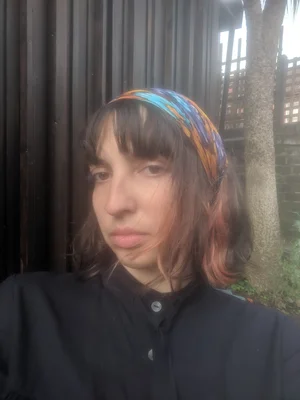 Melis Erdem
Founder of Mother Tongue and studio halbuki ☻
Patchwork cushion covers made from upcycled kilims.
Material: Wool Front & Cotton Back
Measures: 40 × 40cm
Notes: Does not include cushions.